Lots of Little Fires (LOLF) sits at the intersection of storytelling, systems change, and community leadership. From a funder’s vantage point, it is both a practical tool and a living example of the kind of kaupapa we choose to stand behind: locally grounded, led by people with lived experience, and quietly, but decisively, reshaping how decisions get made in our region.
As Len Reynolds Trust (LRT), our relationship with LOLF has moved well beyond a traditional grant. When organisational change placed its future at risk, we advocated for its transition into community stewardship, helped shape a new governance model, and committed to act as an anchor funder for its next phase. What follows is our perspective on why we see this mahi as important, and what it has required of us as a trust.
Why Lots of Little Fires matters to us as a funder
LOLF was born within the Waikato Wellbeing Project (WWP) as a storytelling platform focused on community-led systems change. From the outset, the kaupapa aligned strongly with our strategic priorities: children and young people, Māori communities, equity, and approaches that shift practice and power rather than simply adding more programmes.
What distinguishes LOLF, from our perspective, is that it does three things at once.
First, it centres leadership from people with lived experience, whakapapa, and genuine community connection to the issues being addressed. Stories are shaped by those most impacted, not by external institutions positioning themselves as heroes.
Second, it uses story explicitly as a systems-change tool. The focus is not simply on inspiring narratives, but on shifts in thinking, practice, power, funding behaviour, and institutional culture.
Third, it operates within a disciplined ethical and Te Tiriti-aligned framework. Consent is relational and ongoing. Safety and anonymity are carefully considered. Data sovereignty and mana are respected. This matters deeply to us as a funder: our integrity is bound up with the projects we support.
For us, LOLF is not “content” to be consumed. It is infrastructure for relational, values-led change. It helps decision-makers see and understand people they might never otherwise meet, on their own terms and in their own environments.
What we are seeing in practice
Over recent years we have seen LOLF stories function as catalysts in very concrete ways.
At the Western Community Centre, a story about youth work helped galvanise support for a dedicated youth hub, contributing to a coalition of partners - including local government and lottery funding - backing the vision.
At The Serve, storytelling about the loss of a community space became a shared reference point for partners working together to secure a new home.
Through Manaaki Rangatahi ki Waikato, a story on youth homelessness significantly lifted visibility and helped secure funding for a coordinator role to sustain the work.
We have also seen stories used inside boardrooms and funding discussions to bring context and nuance into decision-making. They are referenced between funders as a way to ground abstract talk of “systems change” in real people and real places. Community partners use them as shared language, reducing the need for repeated, extractive self-explanation.
The videos and written pieces function as relational bridges. They carry trust, texture and context across institutional boundaries. For a funder, that changes the quality of conversation, and the quality of decisions.
Why LOLF feels different from standard storytelling projects
Many funders support communications work. What makes LOLF distinct, and why we were prepared to invest significant leadership time in its transition, is the integrity of its underlying disciplines.
Lived experience leadership is non-negotiable. Decision-making power about what is told, and how, sits primarily with those who hold lived experience or whakapapa connection to the issue. This protects authenticity and mana.
Stories are selected through a systems lens. They must illuminate structural issues and show a shift in thinking, relationships, funding behaviour or practice. The emphasis is on change in systems, not simply celebration of resilience.
Ethical storytelling practice is embedded. Consent is ongoing. Aftercare is considered. Safety is prioritised over publicity.
There is also a deliberate learning loop. Stories are translated into field notes and insights that inform practice and strategy. This means the kaupapa generates not only moving narratives, but analysis that funders and practitioners can act on.
When we invest in LOLF, we are not funding beautiful videos alone. We are sustaining a piece of social-change infrastructure that supports better relationships, better accountability, and better decisions across the ecosystem.
Our role in the transition to community stewardship
When WWP signalled organisational change, the future of LOLF became uncertain. The risk was not only operational disruption, but loss of continuity, whakapapa and community trust.
As a funder that had seen its catalytic value first-hand, we chose not to remain passive.
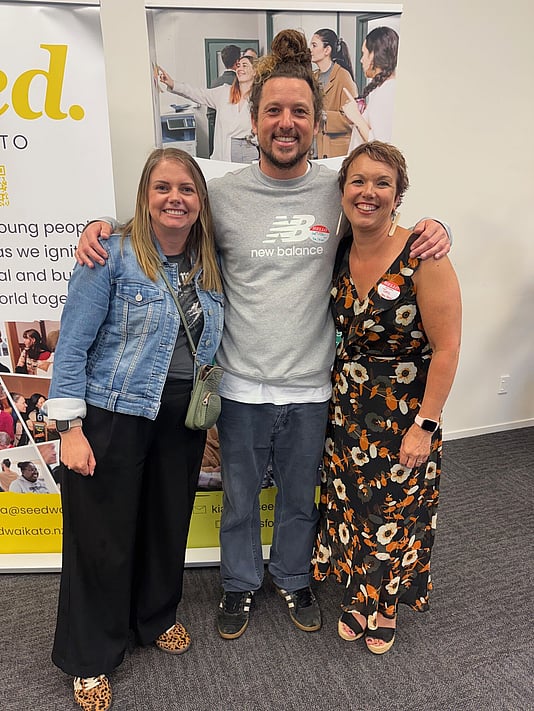
With Board approval, we advocated for the kaupapa to move into community care rather than be dissolved or absorbed into a less values-aligned structure. Following agreement from WWP to formally release the initiative, Seed Waikato was confirmed as fund holder and kaitiaki. A Kaitiaki Rōpū comprising Seed Waikato, Len Reynolds Trust and Creative Waikato now holds governance oversight of values, editorial integrity and long-term wellbeing.
WWP continues to be permanently acknowledged as the origin — “Born within the Waikato Wellbeing Project” — honouring the whakapapa of the kaupapa.
We also supported the development of a clear intellectual property and stewardship framework. LOLF is treated as a taonga held in trust for community benefit. It cannot be sold or privatised, and any future stewardship decisions must prioritise community wellbeing above institutional interests.
Because Joe Wilson is both a trustee of LRT and the visible kaitiaki of LOLF, we implemented robust conflict-of-interest processes: papers circulated without him, recusal from discussion and decision-making, and formal documentation in the conflict register. For us, this was important. Relational, values-led funding must be matched by rigorous governance.
Anchor funding and shared responsibility
To provide stability and signal confidence to co-funders, our Board approved a grant commitment for 2026, staged across the year. We have been explicit that this is anchor funding, not sole funding.
Our intent is to demonstrate belief in the kaupapa and invite shared investment. We want LOLF to be sustainably resourced by a community of funders who understand story as a systems lever.
Beyond pūtea, our CEO has contributed time to hui, governance design, documentation, and outreach to other funders. This connective work does not show up in simple grant metrics, but it has been essential in ensuring the next chapter is viable and well-held.
What this reflects about our wider funding practice
Our involvement with LOLF has both reflected and stretched our approach as a trust.
It has required us to back a kaupapa mid-transition, with uncertainty and risk. It has required us to invest in advocacy and design work outside traditional grantmaking. It has required us to share stewardship without seeking control.
Most importantly, it has required us to accept that some of the most meaningful outcomes are shifts in narrative, relationships and power that are not easily counted.
LOLF is an expression of the direction we are moving: from transactional to relational funding, from programme outputs to systems influence, from speaking about communities to ensuring communities speak for themselves.
It embodies our commitments to Te Tiriti, equity, and partnership in practical form.
Looking ahead
As LOLF continues under Seed Waikato’s stewardship, we see our ongoing role in three ways.
As a learning partner, drawing on stories and insights to inform our own strategy and public voice.
As a connector, using our relationships with other funders and institutions to support sustainable resourcing and understanding.
As a steward alongside others, participating in the Kaitiaki Rōpū to uphold values, ethics and long-term wellbeing without seeking to control the kaupapa.
For Len Reynolds Trust, Lots of Little Fires is both a project we fund and a practice we are learning from. It is teaching us what it looks like to treat story as infrastructure, to share stewardship responsibly, and to stay close to the communities whose small, steady fires are quietly reshaping the systems we all live within.